
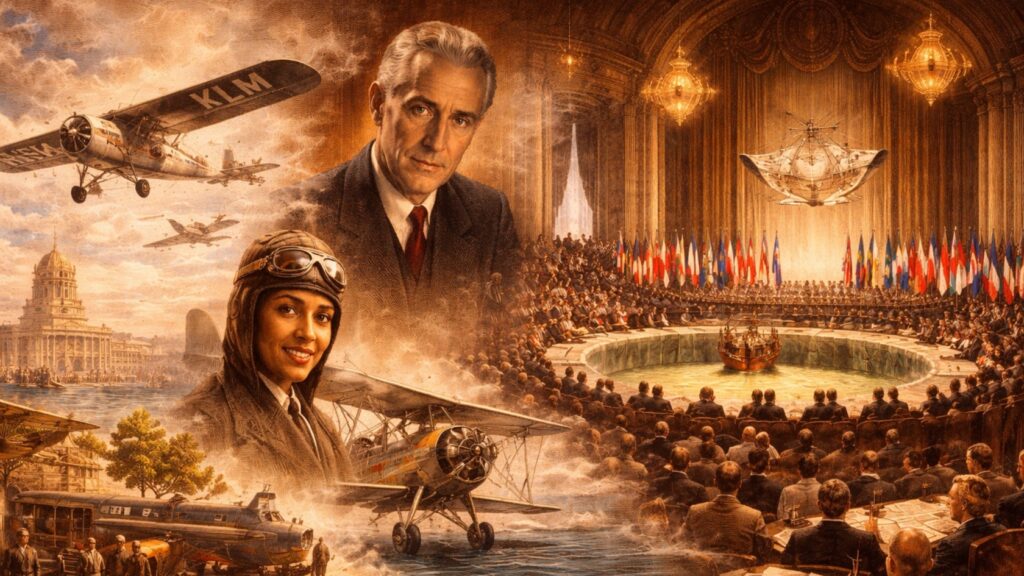
After the Paris Convention of 1919, civil aviation had taken its first major step toward international cooperation. However, that achievement marked only the beginning of a new era. Starting in 1920, flying ceased to be a purely technological or military experiment and became an economic and strategic activity on a global scale. This transformation made the need for a more solid and universal regulatory framework increasingly evident. That same year, the Dutch airline KLM was founded, the first international air route between Key West and Havana was inaugurated, and postal and passenger connections between Seattle and Vancouver strengthened the development of a unified air network in North America.
In 1921, the growth of aviation accelerated with the first regular transcontinental airmail service between New York and San Francisco, operated by the United States Postal Service. At the same time, aviation broke social barriers when Bessie Coleman became the first African American woman to obtain an international pilot license, while Latin America positioned itself in the sector with the establishment of Mexicana de Aviación.
By 1922, the institutional evolution of international aviation found a decisive leader in French jurist Albert Roper, regarded as one of the architects of the 1919 Paris Convention and later the first Secretary General of PICAO, the precursor of ICAO. That same year, the civil aviation industry continued to advance and demanded new regulations, as shown by the first night commercial flight between London and Paris and the first aerial crossing of the South Atlantic carried out by Portuguese pilots Gago Coutinho and Sacadura Cabral.
The development of aviation intensified in 1925. At the beginning of the year, three French aircraft completed a 6,000-kilometer crossing of the Sahara Desert, demonstrating the capability of airplanes under extreme operational conditions. However, the greatest boost to commercial air transport occurred on February 2 with the approval of the Kelly Act in the United States, which enabled private companies to transport mail on behalf of the government and gave rise to airlines that later became global references. That same year, the passenger experience began to emerge as a commercial priority with the first film projections onboard. Meanwhile, the First International Conference on Private Air Law in Paris created CITEJA, the body responsible for codifying private air law for the next two decades.
From 1926 onward, aviation continued to expand internationally, and with it, the need for common rules between States. Milestones such as the flight of the Spanish seaplane Plus Ultra to Argentina, the Madrid–Manila expedition of the Escuadrilla Elcano, and the first aerial crossing of the North Pole captured worldwide attention. Institutionally, 1926 was equally decisive: the International Aircraft Register was created and the International Federation of Freight Forwarders emerged in Vienna, reflecting the growing link between aviation and global commerce. That same year, the Ibero-American Convention on Air Navigation was held in Madrid to align the Paris Convention with the Latin American context, although it was never ratified. The year closed with the publication of the first bulletin of air navigation rules produced by CITEJA, a key step toward the formal codification of air law.
In 1927, while long-distance flights continued to dominate headlines, it was the legal and institutional developments that shaped the future of aviation. Charles Lindbergh’s flight in the Spirit of St. Louis between New York and Paris proved the viability of nonstop transatlantic flights and accelerated commercial expansion. In the Caribbean, West Indian Aerial Express became the first successful scheduled airline in the region, operating initially in the Dominican Republic and later adding routes to Haiti and Puerto Rico. Its rapid growth caught the attention of Pan American, which purchased the Dominican carrier in 1928 to secure regional dominance. That same year, Amelia Earhart became the first woman to cross the Atlantic as a crewmember, setting an important precedent for women’s participation in aviation.
Beyond operational achievements, the foundations of international aviation law continued to strengthen. On February 15, 1928, the Sixth International American Conference was held in Havana, where the Convention on Commercial Aviation confirmed the principle of State sovereignty over national airspace. One year later, on October 12, 1929, the Warsaw Convention for the Unification of Certain Rules Relating to International Air Transport was signed, establishing common principles for documentation and carrier liability, and becoming a cornerstone of global civil aviation law. It was no coincidence that in 1930 Albert Roper warned: “No international air traffic would be possible if a pilot flying, for example, from London to India had to comply with six or twelve different sets of regulations.”
The 1930s consolidated the technical maturity of aviation. Flights by Amy Johnson, Clyde Pangborn and Hugh Herndon Jr. demonstrated the operational reliability of aircraft. Meanwhile, the 1933 Rome Convention introduced rules for liability for surface damage caused by foreign aircraft, and the first International Sanitary Convention for Aerial Navigation was adopted in The Hague that same year. Mid-decade, the arrival of aircraft such as the Douglas DC-3 transformed the industry and marked the beginning of modern air transport. Tragedies also contributed to regulatory progress: the 1937 Hindenburg disaster underscored the urgency of stricter safety standards. In 1938, the Fourth International Conference on Private Air Law reinforced the system of liability and standardized aerial maritime rescue assistance, reflecting the parallel evolution of technology and regulation.
Despite legal progress, the geopolitical reality would alter the course of aviation. On September 3, 1939, following the invasion of Poland by Germany, the Second World War began and commercial air transport was interrupted across much of Europe. The aviation industry was redirected toward military needs, yet international cooperation remained a necessity. The first years of the war saw the emergence of liquid-fuel jet-powered aircraft, opening a new technological era. Even in the midst of conflict, commercial aviation remained active. Pan American Airways continued operating transoceanic routes with the Boeing 314 Clipper, demonstrating that air transport was indispensable even in wartime.
The attack on Pearl Harbor on December 7, 1941 immediately brought the United States into the war and triggered unprecedented aircraft production. By 1943, global manufacturing had expanded exponentially, making it evident that aviation after the war would be far larger than before. Humanity was entering the era of the airplane, one that would surpass the era of maritime dominance, and it was increasingly clear that global air navigation could not function under a fragmented regulatory system.
Even States not directly involved in the war continued to develop their civil aviation sectors. In the Dominican Republic, July 1, 1944 marked a milestone with the creation of Compañía Dominicana de Aviación, which began operations three days later and established the foundation of national air transport. That same year, with the war still underway and the need to prevent aviation from becoming a source of conflict among nations, the most influential conference in the history of civil aviation was convened. From December 1 to 7, 1944, fifty-two countries met at the Chicago Convention to ensure the safe and orderly development of international civil aviation and to harmonize technical, operational and safety standards. From that conference emerged the Provisional International Civil Aviation Organization (PICAO), conceived as an independent multilateral body dedicated to global aviation regulation.
Three years later, in April 1947, PICAO officially became the International Civil Aviation Organization (ICAO), which continues to serve today as the governing body of global civil aviation. With its creation, this historical period came to a close. An industry born amid achievements, uncertainties and conflict finally attained a stable, permanent and universal legal framework to guarantee the safety and order of international air navigation.